Breaking and Entering: Filmmaking for the Uninitiated

Just over a year ago, following a string of disastrous graduate jobs, I finally admitted to myself that being a general punchbag for a narcissistic fantasist with too much pocket money is, in fact, soul-destroyingly futile. Instead, I taught myself to edit, took a storyboarding course and decided it was finally time to revisit that childhood dream of becoming a film director.

Being pretty clueless with no industry ties or contacts, it was clear that I was setting myself up for many years of abject poverty, general disappointment and yapping at the heels of low-budget indie outfits who may or may not turn out to specialise in donkey porn for an East Timor niche market. These facts I was prepared for. Others I was not. For those of you considering embarking upon a career as a teeny tiny unappreciated minnow in a vast nepotistic ocean, here are my top four nuggets of wisdom to help prepare you for your glorious quest.

1. The Film Industry is a Breeding Ground for Misogynistic Halfwits.

When I was nine, my grandfather told me that I couldn’t be a film director because I was a girl and girls don’t get to be film directors. Having never found this biological quirk to have been much of a hindrance before (and bearing in mind that my grandfather was also an alcoholic who would frequently call at 4am to garble lines from Macbeth over and over until someone hung up on him) I decided not to set too much store by his gin-addled career advice. Terrifyingly, it seems he was a little bit right.

For the first six super-keen months, I found myself at industry networking events where I was variously told that I ‘don’t look like an editor’ that ‘women aren’t really seen as directors’ or, at best: ‘You mean you want to be a producer?’ It used to be said that behind every great man is a great woman; behind every great director there is, necessarily, a formidable producer. Producers, then, as the all-organising, multi-tasking, non-limelight-stealing backbone of filmmaking are, according to this patriarchal logic, singularly permitted to be women. For other roles: girls – expect to fight tooth and nail for every tiny grain of respect, and to have any beginner’s gaps in your professional knowledge attributed to that glaing lack of a penis between your legs.

2. Beware the Mentals.

My first ‘job’, as an Assistant Director on a short film, consisted of disaster management for a delusional egoist who had cast himself and his family members in a film about a man who has an affair that costs him his marriage. In the process, he fucked up his own marriage so resoundingly that I spent most of my time providing counselling and tissues to his distraught better half.

He then asked me for feedback on his next project: a short film about child molestation. This he described, with characteristic modesty, as the most powerful, unflinching work about this issue ever to be conceived. In fact, it turned out to be a sick, incomprehensible and utterly offensive tirade that included lengthy ‘stage directions’ debating the existence of God before inexplicably giving way to an eight page poem dedicated to Elizabeth Fritzl. My gentle suggestion that this was, perhaps, not the most sensitive way of approaching the subject matter led to a torrent of abuse telling me that (1) our friendship was over, (2) I was ‘a silly little girl’ and (3) he hoped I would live out my days in perpetual terror of my own children being abused, as just reward for failing to recognise his insurmountable genius.

3. It’s All About the Hierarchy.

Film is second only to the military in its rigid upholding of professional hierarchies. It is probably no accident that the Director of Photography on the last feature film I worked on still carries the bullet wounds from a previous stint in the Italian Special Forces.

Occasionally, on small, no-budget shorts, everyone pulls together in mutually respectful collaboration and harmony, suffusing the set with joyous enthusiasm that prevents you caring that the shoot has run over by seventeen hours, you haven’t eaten since Tuesday and your last tube left last week. Most of the time, however, being at the bottom of the food chain, your main purpose is to lurk miles from the action in the freezing cold, luring wild animals away from set by feeding them strips of your own flesh, whilst somewhere far away a psychotic 1st AD screams hysterical abuse down a walkie talkie because you forgot to remind her to tie her shoelaces and the Focus Puller’s sandwiches are cut into the wrong geometric shapes.

If you can stick out the ritual humiliation for long enough, you may be rewarded with your very own minion to torment – and one day, maybe even a whole crew to bully, threaten and cajole. This is called ‘making a film’.

4. Do it for Love. Not for money.

There’s nothing like that magical feeling when it all falls miraculously into place, better and more beautifully than you ever imagined it would. Sadly, that feeling is rarely the herald of any real world pecuniary relief. So don’t get carried away just yet: you’ll still need that bar job to pay the rent.
Nothing to Hide: Hypocrisy, Sensationalism and the Media Feeding Frenzy

Channel 4’s shockingly biased documentary and the collapse of the News of the World amount to the same thing: the shameless moral arrogance of a self-serving media machine.

In 2009, after nearly three decades of conflict, the Sri Lankan civil war was brought to an end. There has been intense speculation as to what took place in those final months, with both the Sri Lankan government and the insurgent LTTE accused of war crimes by the international community. To make matters worse, Sri Lanka’s prevention of overseas journalists from entering the war zone and ongoing suspicion of the Western Media means that there are no independent accounts of the these events.

This, as multitudes of journalists have been keen to point out, does not exactly help the Sri Lankan government when it claims adamantly that it has nothing to hide. However, making an extraordinary bad PR move is not the same as being automatically guilty of all crimes levied or invented, as Channel 4’s documentary Sri Lanka’s Killing Fields, aired on the 14th June, would have us believe.

Armed with the unexamined testament of a handful of unidentified people claiming to be witnesses and some deeply distressing but largely unattributed (and in some cases doctored) footage, Channel 4 declared that they had absolute and unequivocal proof that the Sri Lankan government had launched a full blown genocide upon the Tamil population in the LTTE occupied North and East of the country.

No explanation was offered as to how this footage came to be in the hands of the producers. No attempt was made to incorporate the accounts of Sri Lankan army or government representatives, or even civilians who may have had a slightly different take on events. Allegations sourced through hearsay about government policy were recycled without bothering to provide sources, evidence or any attempt at analysis; facts were instead replaced with highly emotive but largely irrelevant horror stories about botched operations on children in refugee camps and lingering, voyeuristic images of naked female corpses. Bizarrely, for a programme seeking to ‘expose the truth’, the documentary also heavily insinuated that President Rajapaksa is an autocratic dictator, when in fact his democratically elected leadership of the country has never been contested.

As investigative journalism by the BBC and Al Jazeera, has shown, it is likely that the combined actions of the Sri Lankan army and the LTTE brought about a far greater number of civilian deaths than has so far been admitted. It has also been revealed that, having initially denied bombing in ‘no-fire zone’, the army has now conceded that it did shell within this area, leading to damage to a Red Cross Hospital and resulting deaths, on the grounds that the LTTE was deliberately firing from, and keeping heavy artillery in, this location. Tamil witnesses have reported that shelling came from both sides, leaving them trapped in the firing line, whilst the UN has concluded that at various stages during the war the LTTE deliberately used Tamil civilians as a ‘human shield’.

The acts of the LTTE do not excuse those of the Sri Lankan government, but they do substantially change any attempts to get to the truth of the matter. It is very possible that the Sri Lankan army pursued its course with excessive aggression at the cost of innocent lives. If this is the case, it must, of course be investigated. However, labeling insufficient regard – even criminally insufficient regard – for human collateral as conscious race-related genocide is incredibly dangerous, sensationalist, self-serving behaviour. It may boost ratings, but it does so by manipulating and misleading viewers and, far more importantly, it validates Sri Lanka’s apprehension of Western intervention and threatens rehabilitation efforts in Sri Lanka by reigniting the race hatred, resentment and distrust which inspired the terrorist organization LTTE and brought about the war in the first place.


Moreover, despite calling for a full investigation into the videos it displays on the programme, despite repeated requests and evidence to suggest that the perpetrators could, in fact, have been the LTTE, Channel 4 has so far refused to hand over copies to either the Sri Lankan government or the United Nations. In short, it attempts to take the moral high ground by parasitically propagandizing the troubles of a war torn nation for its own commercial ends, whilst ultimately risking the safety of the very victims it claims to champion. This, it is suffice to say, is hardly responsible, honest journalism.


Of course, Channel 4’s self-interested ‘moral outrage’ is only the tip of the iceberg. Over the past week, the British public’s faith in the integrity of the press has been shaken to an unprecedented degree. Accusations of telephone hacking and bribery, which were widely and repeatedly dismissed by the police force, the press and the government (notably Mayor Boris Johnson, who called this “codswallop”) have not only resurfaced, but have been shown to be far more extensive, and far more sinister, than even the whistleblowers themselves had thought possible.


The result, a spate of arrests and the sudden closure of the News of the World, one of the UK’s longest running and most influential newspapers, stunned the nation. More importantly, a gulf is rapidly forming between popular fury and the reluctance of many politicians, the Prime Minister included, to investigate the accused.

Cameron’s “friendships” with Rebekah Brooks and Andy Coulson have been well documented, as has the reverence shown to Rupert Murdoch, not only by Cameron but by predecessors such as Tony Blair. However, it is only now that the full extent of his hold over UK politics has been revealed. Despite admitting bribing police, Rebekah Brooks reportedly told senior officials that if they proceeded with her arrest, their private lives would be publicly torn to shreds. In a Newsnight interview on the 8th June, the day after the closure of News of the World was announced, Labour politician Harriet Harman claimed that the last government cowed to the “menacing presence” of the Murdoch empire, altering its own stance and permitting illegal activity to continue, because it was afraid of its power to control public opinion. Meanwhile, on the same programme, NOtW journalist Paul McMullan maintained that those in the public eye, whether consensually or otherwise are not entitled to any degree of privacy – even that guaranteed by law – and that regularly breaking the law in order to gain a scoop on anything that ‘the media’ decides is newsworthy is entirely fair game, and represents a free press. If people have ‘nothing to hide’ he claimed, with breathtaking KGB-style reductionism, they would not mind being spied upon.

Cameron’s refusal to condemn the role of Brooks, Coulson and, crucially, Murdoch, despite this furore and the criminal behaviour that has been repeatedly admitted to, indicates that fear of the media giant still resonates, even in the most powerful circles.

And, of course, it is not just in the UK that Murdoch holds sway. News Corporation has succeeded in building a global empire of ‘thought leadership’ channels spanning print and television in some of the most powerful nations in the world.  An empire which has grown, unchecked, because – ironically – those in a position to challenge this blatant monopolisation of opinion and self-serving news are too frightened that they might become the next victim of Murdoch propaganda, should they intervene.

Revelations of government-media power imbalance and effects on the democratic process and – crucially – the way this is used to control and further business interests has bewildered a public that that proved overwhelmingly credulous when faced with a media machine claiming to be acting in its interests. With influential media figures such as Jon Gaunt still pushing for a more lackadaisical approach to TV regulations that will, he expressly states, allow openly party-biased news reporting (i.e. state-sponsored propaganda) to flourish, it is more important than ever that we as a nation learn to read between the lines, and to question the truth, the motives and the methods behind the journalism we allow to influence, and to inspire, our politics.

And This is Where the Carrot Gets Turned Into Poo

Life and the Afterlife, as Told by a Five Year Old

For almost a year now, every Saturday afternoon at 3pm, a bright-eyed, bushy-tailed child prodigy has been deposited upon my doorstep. This charmingly precocious bi-lingual five-year-old is Genius Child* (GC) and my loosely defined weekly mission, for which I am not entirely sure I am qualified, is to Teach Him Useful Stuff.

GC is brilliant fun. He’s exactly the kind of witty, cheeky, chatty and altogether likeable child that makes you forget that most children are screaming, snotty little brats, and start to entertain a dangerously romanticised view of what parenthood will probably be like. With the notable exceptions of writing neatly and colouring within the lines, two things I’ve never been that fussed about, he’s remarkably good at just about everything, including football, chess and, more recently, dispensing advice on how to make homemade tortellini – from scratch.

Moreover, like many children, GC has an extraordinarily active imagination and the ability to ask seemingly straightforward questions that are, in fact, disconcertingly difficult to answer. Fortunately for me, his parents are intellectually curious, religiously unaligned and generally chilled out enough not to question the fact that a lesson that might start off being about Tutankhamen’s tomb or where rain comes from regularly descends into crashing saucers covered in flour together to show how tectonic plates create earthquakes, lengthy discussions about protests in the Middle East or why different civilisations have picked different gods, and pages and pages of scribbled, disconnected diagrams showing what happens when particles heat up, how gravity works, why the Earth has different seasons and how meteors and resulting giant ash clouds could have killed off the dinosaurs – frequently annotated by GC with wonderfully linear comments like “well, why didn’t they just stand there?” or “what would have happened  if they’d built their nests on top of THIS rock?”

It is precisely this linear, wholly credulous train of thought which makes dealing with very young, very bright kids so fascinating: they take everything in, and they take everything literally. At times, I find this enlightening. The questions GC asks have a unique ability to cut straight through the crap, reminding me just how much received rhetoric, cultural conditioning and intellectual laziness contextualises meanings that I think of as definitive, or arguments I had presumed to be self-evidently logical. You’re forced to realise how much of what you say is indirect, obscured by metaphorical, posturing or implicit language, or validated only by reference to assumptions and uncertain principles you have long ceased to investigate and no longer fully understand. It exposes how little we as a species think to examine our perceptions, and the daily interactions we have with the world around us.

Most of the time, though, it’s just really funny.

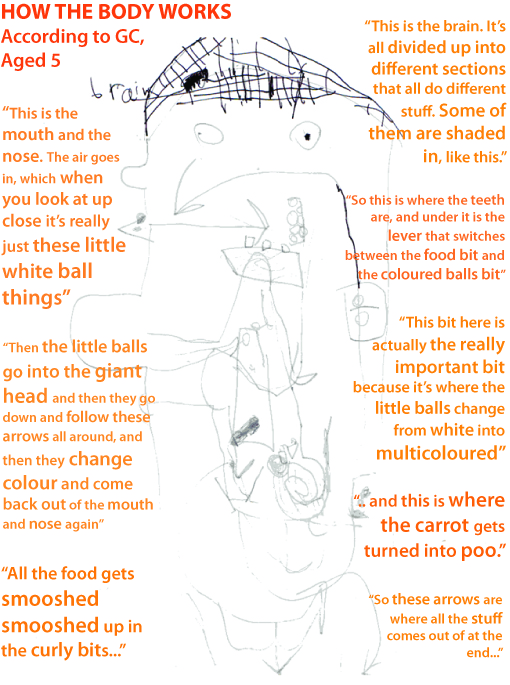
This week, for example, having just returned from a trip to Italy to visit his grandparents, GC arrived at the lesson enthused about a programme he had watched on Italian TV which had explained in some depth the internal workings of the human body. Keen to impart this wondrous new knowledge to me, he then set about recreating the relevant diagrams, accompanied by an excellently remembered (and translated) verbal explanation of what the process involved. It went like this:

“That’s great,” I said. “Very well done. Just one thing – these balls you’ve drawn, the white ones here, they’re oxygen coming in, and the multicoloured ones, that’s carbon dioxide going out. You remember, we learnt about this a few months ago?” GC looked at me wearily. “Yes,” he said. “I know that already. But what this programme was saying is, they’re really little coloured balls”.

Feeling it unwise to confuse him further, I then moved on to the prepared lesson, which concerned the building of the pyramids in Egypt. Reading aloud from his textbook, GC suddenly broke off mid-sentence to ask me whether ordinary people were allowed to have tombs in the pyramids, which in turn led on to a conversation about the comparative benefits of being preserved, buried or cremated.

“But why would you want to burn someone up?” he asked.

“Well,” I said, “Some people like the idea of their ashes being scattered in places they liked when they were alive. The sea, for example.”

“That’s a bit disrespectful to the fishes, throwing bits of body all over them. Anyway why would you care, once you’re dead? It’s not as if you’d know about it.”

Well, quite.

A few moments passed in thoughtful silence as GC contemplated the possibility of post-mortal sentience.

“One thing I don’t get about the afterlife,” he proclaimed, at length. “If I have to leave my body behind, then how will I remember anything? I wouldn’t have a brain.”

“Well… I think the theory goes that the memory and all the rest of it goes up with the soul, which is a sort of ghost-version of you.”

“But what about my legs? How would I play football without any legs?”

“Well I suppose you’d – I don’t know. Maybe they’d give you a new body when you got up there. Specially built for the afterlife.”

“What if they forgot something? Like my nose?”

“You mean, what if they ran out? I don’t know. I don’t think that’s how it works.”

GC pondered.

“To be honest” he said. “It all sounds a bit silly to me. I don’t think there IS an afterlife”.

Richard Dawkins, eat your heart out.

*Name has been changed

What We’re Up Against (Review)

Aorta Theatre Collective presents a vibrant selection of scenes from Theresa Rebeck’s catalogue of razor sharp social satire.

Directed by Rob Hale

New York playwright, ‘relapsed Catholic’ and artful social commentator Theresa Rebeck has a back catalogue as long as your arm of acutely, playfully, hilariously observed satire. Evidently fascinated by the minutiae of human foibles, prejudices, mundane neuroses and twisted logic, her work is a masterclass of witty, energetic dialogue, bizarre non-sequiturs and heightened reality.

With this in mind, it is difficult to imagine how on earth Rebeck, in her own words, very nearly “fell off the map” following a scandalously misogynistic review of The Butterfly Collection in the New York Times in 2000. Despite the outrage of the theatre community and a flurry of complaints to the newspaper, this bad press forced the play to close and, for a time, it was seriously suggested that Rebeck either write under a male pseudonym or just “do something else”.

Thankfully, Rebeck hit back with a raft of superb plays including Mauritius, Bad Dates and the co-written Omnium Gatherum, even attracting a Pulitzer nomination for the latter. She also demonstrated that she could, in fact, “do something else”, by publishing an acclaimed novel, Three Girls and Their Brother, and writing the forthcoming series Smash for NBC – to be directed by Michael Mayer and produced by Stephen Spielberg, no less.

The seven scenes selected for What We’re Up Against, deftly handled by a highly competent cast, encompass issues as diverse as workplace misogyny, funeral parlour mix-ups and a struggling actor who would rather be a barman. All share the sense of quiet desperation that Rebeck specialises in, which infuses the comedy and humanises characters that are, on the face of it, rather unsympathetic.

Each scene is interspersed by shorter pieces from Rebeck’s one act play Mary, Mother of God, Intercede for Us, which shows a harangued, business-suited Virgin Mary, played by the excellent Juliet Prague, overrun by prayer ‘dockets’ and passing on requests of varying urgency and poignancy to a seemingly indifferent God – via the divine medium of her mobile phone.

As the play progresses, this juxtaposition becomes increasingly astute; subtle shifts in the performances between self-interested egotism and overwhelming emotional fragility are intensified by Mary’s increasing despair and rage at the arbitrary way her messages are dealt with- and her powerlessness to influence these decisions. Here, as in countless other examples of her work, Rebeck skilfully takes an exhausted argument and breathes fresh life into it through an imaginative, surprising and highly visual approach.

The cast are infectiously energetic, with Sally Scott’s barely concealed hysteria making for a particularly charged and engaging performance, but at times it felt that more variation in tone could enhance their effectiveness. The more muted delivery by Michael Benz and Tom Cornish in the funeral parlour scene created perfectly balanced tension between restrained fury and agonising grief, but Demi Oyedin, perhaps feeling a little underused, offered a forceful performance that proved slightly too overbearing for such an intimate space. The comic delivery, however, was spot on throughout, frequently leaving the audience helpless with laughter.

What We’re Up Against provides an excellent and intelligent interpretation of some of Rebeck’s finest pieces and the central throughline that binds together her work and ideas. For those unfamiliar with her work, Rob Hale’s selection also offers a perfect introduction to this extremely important contemporary playwright. Not to be missed.

****

The Old Red Lion Theatre, Angel. 8th Feb -3rd Mar 2011.

Through the Eye of the Tiger

This article was written for the dakini Tiger Campaign. To read the original post, click here.

Tiger snuggleA little nap always seemed like the best way to cure writer’s block…

“In a jungle in central India, a Bengal tigress hears a familiar sound and raises her head.

Black stripes weave through her burnt orange coat, distinguishing her from all other tigers. Her tapestry of fur is nature’s art, as individual as a human fingerprint, and it distinguishes her from all other tigers. White fluff surrounds the dark rims of her eyes, making them seem even more luminous than they are. The shining, citrine-colored centers focus on the source of the sound…”

So begins dakini’s breathtaking book TIGERS, written by acclaimed writer and big cat enthusiast Carol Kaufmann. As you all know, the book will be printed in the Spring and the pre-orders have been flooding in at www.tigercampaign.com.

But, in the meantime, we want to give you the chance to take part in a whole new tiger story… this time, written by YOU. On Monday, we’ll provide you with the first line of a tiger story. Then, we’ll ask you to come up with the next line, and the next, and the next, until we have a complete Tiger Tale created as the collective effort of dozens – potentially hundreds – of budding tiger writers.

The experiment will be run entirely through Twitter.  We’ve set up a Tiger Tale twitter account, @dakiniTigerTale, where you’ll be able to watch the story develop and see each new line as it appears. To suggest the next line, simply tweet your idea starting with #tigertale. We’ll then retweet our favourites to form the story.

You’ll be able to browse all the suggestions at any time by searching #tigertale. If you see one you love and you want to ‘nominate’ it as the next line, retweet it – we can’t promise we’ll decide to use it but it will bring it to our attention!

The project will kick off at 12.30 GMT on Monday 17th January – follow @dakiniTigerTale to be kept in the loop. The Tiger Campaign is all about building a future for tigers by encouraging people to understand, empathise and fight for their protection; we’ll be looking for contributions that are not only make for a great story but also show an understanding of and appreciation for these magnificent animals in the wild. We want a story that really does show the world through the Eye of the Tiger.

Good luck and happy writing!

A Very Fine Art

This article was written for the dakini Tigers Campaign. Read the original post here.

Last Tuesday, I went to Asia House in New Cavendish Street, to hear Ruth Padel speak about tracking tigers in the wild and her wonderful book, Tigers in Red Weather.  At university I had read a little of Padel’s poetry and several of her books on Greek theatre – but I had no idea she was involved in tiger conservation.

In fact, Padel is something of a tiger conservation expert and speaks very compellingly and beautifully on the subject. She explained the concept of ‘trophic cascade’, the disastrous effect of removing a key animal or plant, especially a top predator, from the intricately interwoven network of living things in any ecosystem. By taking something out of the cycle too abruptly, the precarious balance between all other creatures can be completely disrupted – leading to a catastrophic population decline throughout the entire system. Padel explained this by taking an example of eight living things co-existing in the same forest: a wild pig, a mango tree, a leafcutter ant, a monkey, an owl, a lizard, a mosquito and a frog.

Essentially (this is a little abridged) after millenia of gradual adaptation, the eight living things are neatly balanced in their shared environment: the wild pigs scratch the earth on the river bank for food, leaving water-filled holes in the mud that make perfect places for frogs and mosquitoes to lay eggs. Some of the mosquito larvae is eaten by tadpoles. The frogs provide food for the owls that make their nests in the mango trees. Monkeys also live in the trees, where they collect and eat the mangoes, spread the seeds as they go and in doing so help new trees to grow. Leafcutter ants collect the fallen leaves to eat and to ’feed’ the fungus they use to incubate their larvae. Lizards rely on the leafcutter ants for food.

Then humans come to the forest and hunt all the wild pigs. Suddenly, there are no muddy holes in the bank for the frogs to lay their eggs. This suits the mosquitoes – they can lay their larvae anywhere damp and, now that none of this is being eaten by tadpoles, they grow in number. The frogs must either die out or leave to find somewhere to lay their eggs, and the owls leave, too, to find other food sources. There are now so many mosquitoes that they are plaguing the monkeys, so the monkeys move on. With the monkeys gone, there is nothing to spread the mango seeds and over time, the mango trees die. Without the leaves from the mango trees, the leafcutter ants can’t eat or breed, and they also leave or die. The lizards have no ants to eat and so they move on, too. Eventually there is nothing left but mosquitoes.

The same principle is true of any ecosystem, and certainly applies to tigers. Tigers are often seen as indicators of a healthy, functioning forest and throughout Asia have been depicted as powerful guardians – of the jungle and of the spirit. Asia House’s Tigers in Asian Art exhibition, which I was lucky enough to take a look around after the talk, vividly displays this clear common theme. One of my personal favourite pieces is a painted Begali story scroll, depicting a series of scenes of a solitary woman who has to give birth whilst journeying through the jungle. She is shown at first heavily pregnant and then nursing a baby boy, watched over throughout by the eyes of a protective tiger.

Another of the exhibition’s striking artefacts was a solid gold tiger head, decorated with emerald eyes and a ruby collar, which once formed part of  Tipu Sultan’s throne in the late 18th century. Dubbed “The Tiger of Mysore,” Tipu Sultan was by all accounts a fearsome warrior, famous for his assertion that ”it is better to live for one day as a tiger than a thousand years as a sheep” and for posing a particular problem for the invading British forces, by whom he was eventually killed in battle in 1799. He was also famous for ‘Tipu’s Tiger’, a huge, rather sardonic music-box style creation which depicts a tiger mauling a British colonial soldier to death; as you turn the handle on the box, the tiger growls and mauls, and the soldier moans in his death-throes. It’s absolutely brilliant.

During the evening, I also got talking to the exhibition’s curators, including Betty Yao, who has invited me to the Tiger Forum being held at Asia House on 7th December. This will be the only event of its kind in London, reporting on the outcome of the International Tiger Summit and discussing how we can, and must, progress in order to give tigers a fighting chance for survival. It was heartening to meet others striving for the same goal – especially as Asia House represents an important cultural link between the UK and countries across Asia. Here’s hoping that this is indicative of a shift in attitudes towards saving tigers, especially in China and its surrounding nations.

Something that Ruth Padel pointed out, which I found fascinating, is that to make a symbol of something is both a benefit and a curse. Many of the key reasons that tigers inspire beautiful artworks and passionate responses – their awe-inspiring beauty and power, their fierceness and independent spirit – are precisely the same reasons that they have been hunted, made into trophies, eaten and drunk by people who come to see them purely as symbols that can be attained and absorbed into oneself. It is crucial to understand that tigers are magnificent, but they are only so when respected in their own field, understood not simply as an image of strength but as a living thing with an intrinsic right to existence. Their magnificence cannot be owned, only admired.

Whilst putting together our book, we have tried to remain mindful of this. We have wanted to avoid simply pulling together images of tigers as lovely to look at and symbols of strength, but to go a step further and to really explore the life of the tiger, its needs and development – to follow the cubs as they grow up and learn from their mother what it is to be a tiger. We have endeavoured at all times to show these animals as rooted firmly in the context of their environment and as belonging exclusively to this. In short, we have sought to celebrate the tiger without making it into a symbol. When we come to take our book and its content to the media around the world and especially in Asia, it is precisely this message which we hope will, ultimately, save the tiger from becoming an historical artefact and instead be seen for what it is: a key element of a vibrant landscape, which we cannot allow to disappear.

www.tigercampaign.com

Tigers in Asian Art is on until 12 Feb 2011, at Asia House, 63 New Cavendish Street, London W1G 7LP.

Yeah, F*ck You, Toby Micklethwait

No. Just, please – no.

Last night I discovered a UKIP “Political Communication” in my kitchen. I do not know how this traumatizing incident came about; presumably the leaflet had been inadvertently intercepted on its journey from letterbox to recycling bin. After initially dropping it faster than an anthrax-saturated hot potato, I found myself seized by the desire to tear it into tiny little pieces, and to send those tiny little pieces back to the lamentable individual who had seen fit to post them to me in the first place. Which, having succeeded in salvaging the relevant address from the remaining scraps, I have now done.

The following is a transcript of the accompanying letter, sent off this afternoon with considerable glee:

Dear Mr. Micklethwait,

I write to confirm receipt of your “political communication”, which I am returning to you, enclosed. I had initially supposed that this would be sufficient to illustrate my feelings towards your party, but it now occurs to me that, given your membership of UKIP, further clarification may be required.

Firstly, as a rational and reasonably intelligent human being, I intend to reserve my vote for a party with the collective mental capacity to (1) comprehend basic environmental concepts, particularly rergarding climate change, and (2) think up a few half-useful policies that are rooted in something other than regressive, xenophobic paranoia.

Secondly, the fact of my having been born in Britain really is little more than geographical fact and a lucky accident – hardly something to base an entire sociopolitical ideology on. One of nicer things about living in this country is that a person’s right to think, act and develop along their own lines is (largely) legally enshrined rather than sidelined in favour of a contrived, idealised monoculture hacked out of nostalgia and senseless nationalism.

Moreover, being from a family whose members include indivduals of New Zealand, Jamaican, Indonesian, Trinidadian, Grenadan and Irish descent, I find your racist, blinkered and frankly pathetic analysis of what is “British” enough to be valuable not only prescriptive but insulting. I recommend that you get out of Surrey, and find a real job. Preferably, one which does not involve wasting public money on whingeing about the millions of British citizens who do not consider a roast potato to represent the dizzy heights of man’s achievement. Perhaps then you will begin to understand what a sad, silly little party you insist upon championing – although I strongly suspect you lack the intellectual rigour for such self-critique.

In the meantime, please refrain from distributing any more of your vile and unwelcome material to my family’s door.

Sincerely,

Lindsey Kennedy

***

Well, now I feel better. If anyone else feels the urge to forward their views (or, indeed, bodily excretions) to Mr. Micklethwait, his address is: UK Independence Party, Runnymede Weybridge and Spelthorne Branch, Hamilton House, Lyne, Surrey KT16 0AN.

Now I just have to decide who I am going to vote for…

Cambridge Invader (Review)

Review published in Varsity Newspaper, 8th March 2009. Cambridge Invader was a weekly feature covering a selection of the city’s (and university’s) lesser-known pubs, bars and secret societies.

Cambridge Invader: Girton College Bar


Our college bar closed on Tuesday. The new one is opening today, and it’s bigger and shinier and hopefully better, but nonetheless Tuesday night was seen very much as The End,  as swathes of current and ex- students poured in to the very limited space for a final nostalgic (and doomed) attempt to secure a lock-in, and to drunkenly sing College songs with misty-eyed enthusiasm and little in the way of coherent melody. Think the Pogues if half of them were actually English Public School veterans. Oh, wait, yeah. Think the Pogues.


As the final closure approached, panic set in. What would we do for two whole days without a cheap bar at stumbling distance? We were fairly sure this constituted a civil rights infringement. Fortunately I had a suggestion. “I know of a place,” I said. “A bar far, far away, where few students have ever ventured before.” The others raised a sceptical eyebrow. “’Tis called Girton” I said. There was a hushed silence. A few of the elders shook their wizened heads. One leaned in conspiratorially, whispering over his ale like an ancient sailor. “Have ye heard the tale,” he hissed, “of the Girton Threesome?” No. I hadn’t. And I didn’t believe it. But now I was more determined than ever to pursue the seldom trodden path to this remote Mecca of mythological debauchery.


The taxi pulled up outside what appeared to be a stately home. J and I hovered, feeling suddenly very isolated and vulnerable. I was reminded of the orgy scene in Eyes Wide Shut and wondered if I should have brought a mask.


We made our way through labyrinthine hallways and down a staircase into an underground bar which faintly resembled an S & M dungeon – all red uplighting, tucked away booths and exposed brick archways. We were the only people there. The bar lady surveyed us wordlessly with a look which said, “you’re not from these parts” and, fearing that our hacked up bodies might one day be discovered under the charmingly unlevelled flooring, we took our bottle of wine (£5.60 and certainly quaffable) and retreated to a corner.


An hour passed. I began to hallucinate tumbleweed. A few people turned up, but all seemed rather docile. Research revealed that the master’s efforts to prevent any Ents being organised has led to a general disillusionment with college socialising, and many Girtonians tend to eschew the bar for local pubs. I later discovered from an ex-member of my college that he’d been banned from the premises after announcing that the Mistress was a “fit little tart” during a formal dinner, which may or may not have had something to do with it. Regardless, I felt let down.


We finished our wine and called a taxi to take us to Cindies. As we made to leave, however, there was a sudden influx of people, establishing a highly satisfactory male-female ratio. Perhaps we were making a mistake? Just then, two previously unclocked FOLs blocked our path. “You can’t leave now!” they cried “THE SHOW’S JUST BEGINNING!” … and proceeded to strip, rapidly, to their boxer shorts. This was more like it. The bar lady nodded at the trousers around their ankles and snapped, “pull them up or take them out” with an unsurprised irritation which suggested the scene was commonplace. J and I began to reconsider our decision. Cindies, however, beckoned, and unable to persuade the men in question to accompany us, and unwilling to pass up our taxi to pay homage to the site of the – apparently real – threesome, we reluctantly departed. But we will be back. There’s untapped talent up there, girls, and the numbers are in our favour.