Want to Make the World a Better Place? Become a Banker

If you’ve ventured outdoors just about anywhere in Britain over the past few weeks, the chances are you’ve seen some familiar signs of the season. Hollow-eyed undergrads bulk-buying Red Bull. Cafés full of teenage girls clutching gel pens like talismans. Parks crowded with library refugees, huddled together among blankets and books. It’s that time of year again: the exams are here.

In the coming months, 350,000 UK graduates will take their first, intrepid steps into the job market. Compared with the past six years, things are looking up for the Class of 2014; many graduate jobs, killed off by the economic downturn, have been resuscitated, along with a record number of paid internships. Perhaps for the first time since the crash, bright young grads choosing a career path can afford to feel optimistic about their prospects.

But how to choose this path? For those primarily interested in money or prestige, this might be a comparatively easy question; a plethora of high-profile career-fair-botherers from the legal, accounting, financial and management consultancy sectors offer attractive packages for graduates. But for the growing number of young idealists that want to make the world a better place – or at least not to make it any worse – it’s a trickier one to answer.

Continue reading →

Sexual Overload: Is it Screwing with Our Heads?

In 2006, three psychologists made a startling discovery. Just being in the presence of money, or even visual cues that remind us of money, makes people more selfish and unwilling to co-operate. Even though such behaviour offered participants no actual financial gain, the connotations of capitalism and its attendant self-interest was enough to significantly alter their short-term attitudes and behaviour.

Other studies have shown similar patterns. A team at Duke University found that exposure to the Apple brand caused people to exhibit more creativity in a task than participants shown logos less closely associated with creativity. Chen-Bo Zhong and Katie Liljenquist explored the way in which the metaphorical concept of cleansing our sins to absolve ourselves can be triggered with visual cues, finding that participants were drawn towards physical cleansing products after experiencing a sense of moral shame and felt diminished guilt or obligation to others after undergoing a physical cleanse.

Merely referencing an ideology, a pattern of behaviour or an accepted metaphor embedded in language can have an astonishing effect on preferences and behaviours. And sexual language is no exception.  Continue reading →

Adventures in Berlin: In Search of Cool

We finish our fifth beer in the shabby-but-charming Zum Schuster Jungen and sink sleepily into our chairs. This is a no-nonsense pub, selling no-nonsense German grub: the remnants of three pork knuckles, one fried fish and four gooey stacks of sauerkraut wallow, unfinished, in our greasy plates. Behind the bar, two sturdy Teutons raise an eyebrow at our defeat.

Nestled amid the posing, self-conscious cool of modern Berlin, the pub is a peculiar anachronism: a relic of the pre-unified East, where both flat caps and floral wallpaper are worn without irony. Part of me wants to abandon our quest for the avant-garde and settle in here for the night, but the choice is made for us by a robust waitress who indicates that we should give up our table for newer, hungrier arrivals. We hand over our money and haul ourselves into the street.

“Hang on,” says Joe, pointing at a nondescript building on Eberswalder Strasse. “I think this is it.”

Continue reading →

Coursera and the Art of Brevity

I admit it: I have a problem. My family is concerned, my friends are perplexed and my boyfriend is beginning to despair. Due to a crippling psychological disorder, I am physically unable to allow pockets of free time to creep into my hectic work-life schedule.

That’s not to say that I’m some kind of superwoman. Far from it. I’m just as susceptible as the next person to naps and YouTube and all-encompassing hangovers that last until 10pm the following day. My problem is that I see a week of free evenings stretching out ahead of me and, instead of thinking, “Great! I’ll piss about and go to the pub and watch an entire series of House of Cards,” I think to myself, “Great! I’ll learn Spanish and write a novel and master macroeconomics.” At which point I piss about, go to the pub, watch an entire series of House of Cards, then panic and try to squeeze 6 months’ worth of intellectual activity into the hours I should be sleeping on a Sunday night.

The latest enabler of my addiction is Coursera. If you haven’t discovered it yet, take a look: it’s amazing. Coursera is a website where you can sign up for online versions of degree modules from major universities, wherever you are in the world, for free. These are made up of video lectures and set reading, and are assessed through multiple choice tests or short essays, depending on the demands of the course.

Continue reading →

The Kindness Contract: Has Rejecting Religion Made Us Better People?

Ariane Sherine’s article in Tuesday’s Guardian, Why I Ditched God for Good was a clear, open call to action: whether you’re an atheist or a believer of any faith, what matters most is that you are kind.

So far, so uncontroversial. But, with such a provocative title, it is perhaps unsurprising that her message was rapidly quagmired in religious debate. 819 comments were posted in the article’s first six hours online, the most incendiary of which questioned the motivations of kindness in a godless world. Continue reading →

Skins: a shiny shiny shrine to all that is wrong with TV

Ah, Skins: a menagerie of awful, entitled, jaded rich kids doing awful things to each other whilst seemingly getting a sexual kick out of this posturing, faux-nihilistic awfulness. Occasionally, we are asked to suspend our disbelief whilst the unbearable little shits export their particular brand of awfulness to a range of exotic locations, unlikely warehouse raves and/or what appears to be the set of Brighton Rock, all the while uttering the kind of wallowing, baseless, psychology-by-numbers banalities that make Amy Childs seem insightful and complex.

Inexplicably, according to Skins, no one in Bristol has a Bristolian accent, jobless teenagers never run out of cash and no one under 30 can act, with the possible exception of (OMG LIKE SO FUCKED UP!!!!) Franky’s psychotic cockney drug-dealing love interest, a sort of Scum-era Ray Winstone-cum-Topman model.

Unless the world has changed beyond all recognition in the seven years since I left sixth form college, the only thing amongst this drivel which actually rings true is the pervading sense of vacuity and selfishness that permeates all adolescent activity. All that is revealed by C4’s extended turd-polishing exercise is that, for all their slender limbs and agonised pouts, the lives of 17-year-olds are just too boring to stomach without a liberal smattering of violent sex, hourly drug intake and ill-conceived ‘serious issues’ to sledgehammer away any semblance of reality and/ or meaning. Luckily, there’s plenty of jumpy editing, elaborate sound design and the odd hallucination or dream sequence to distract from the very silly script, allowing the audience to focus their attention on what the cast do best: lolling around in their underwear, reciting clichés, with narrowed eyes and flat, plummy-voiced resolution. Gripping stuff.

Skins: The Young Offenders

Dreadful People.

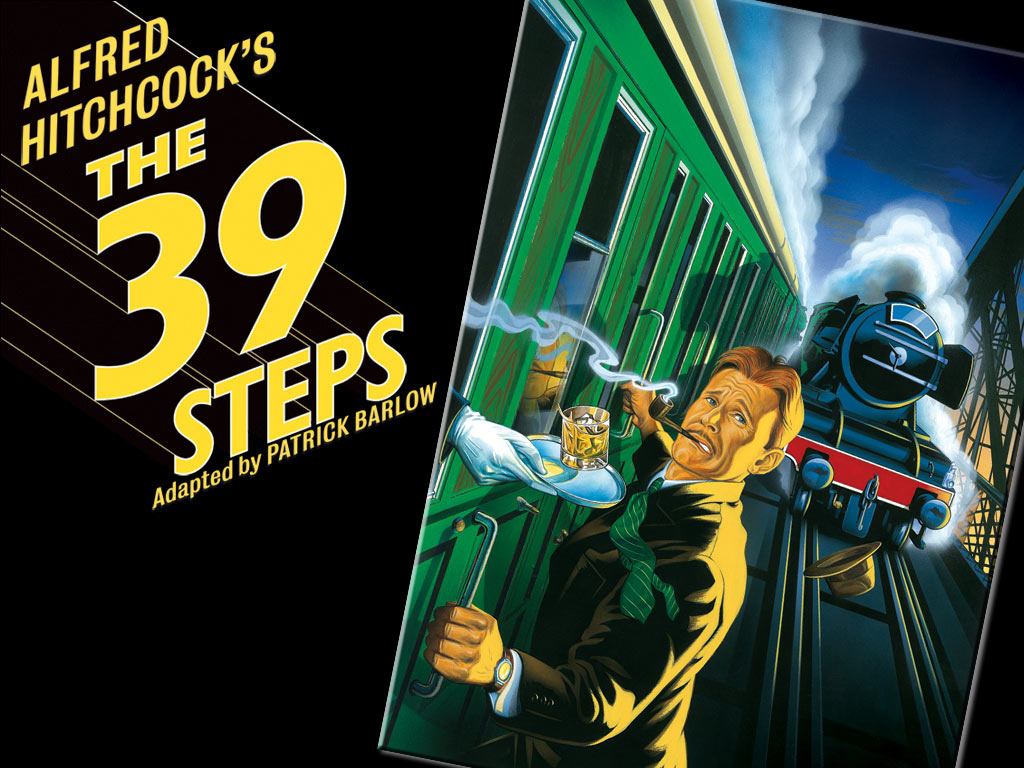
The 39 Steps @ The Criterion

The Criterion Theatre, hidden under London’s Piccadilly Circus, is a glorious relic of Victorian excess. From the faded red velvet curtains to the cherubs that spill across an extravagantly ornate ceiling, the decor is an intriguing mix of gaudy music-hall glamour and opulent high aestheticism. The onset of slight shabbiness only adds to its antiquated charm.

Practically and stylistically, the venue is also perfectly suited to Fiery Angel’s wonderfully inventive reimagining of The 39 Steps. The play features two scenes in a London music hall, allowing the staging to open up into the auditorium and involve some tongue-in-cheek audience participation. Moreover, the surroundings lend themselves to director Maria Aitkin’s evocation of a once wealthy London in post-WWI decline, and to the production’s bawdy, theatrical brand of comedy.

The plot draws heavily on Hitchcock’s 1935 film, rather than the earlier novel. Returning to Blighty from a stint overseas, quiet-living über-Englishman Richard Hannay (Andrew Alexander) finds himself wrongfully accused of murder and embroiled in a treasonous plot. On the run, searching for the truth and inconveniently chained to a disobliging blonde, Hannay is pursued from London to the windy Scottish highlands by inept police, corrupt officials and a stern Scottish farmer with an impenetrable accent and a lustful young wife.

Catherine Bailey plays all three love interests – with enough skill that it took me a while to realise this – whilst all other roles are handled by the hilarious Stephen Critchlow and Ian Hughes. Much of the humour is drawn from watching the pair switch rapidly between villains, newspaper sellers, milkmen, train passengers, B&B owners and more, occasionally even conducting conversations with themselves in the process. In one memorable scene, A nightie-clad old lady (Critchlow) argues with a policemen at the door (also Critchlow), before spinning round to continue the argument as the policeman and revealing a completely different costume on the other side of his body. The production fully embraces these farcical elements, frequently making self-conscious jokes about the limitations of the props and set and, in an intriguingly post-modernist twist, actually scripting in mistakes and late cues for added comedy.

Despite poking fun at the mock-simplicity of the set, the technical elements of the production and the ingenuity of the cast, director and set designers are evident. The shadow-puppet sequences that replace complicated chase and crowd scenes are amusingly childlike, but also perfectly realised and surprisingly effective. At the heart of the production is a wry reference to the artifice essential to ‘realist’ theatre (and film) and a refusal to allow the audience to engage fully with this artifice. In doing so, the production frustrates any attempt to become emotionally vested in the play – tension, empathy, relief are all dissipated by the reminder that what we are seeing is blatant construction – but it does make for very entertaining viewing. For all its slapstick silliness, The 39 Steps provides a sophisticated comic reaction to immersive drama; one in which the puppets wilfully point out the strings.

39 Steps - Poster

The Origins of Sex

Faramerz Dabhoiwala @ LSE, 7th February 2012

You only have to skim through a few choice passages of Beowulf, Malory’s Morte d’Arthur, or Chaucer’s Troilus and Criseyde to discover that the Medieval woman was a salacious beast. Lustful, insatiable and morally incontinent, she frequently needed to be locked up for her own good, and for the good of the bewildered, pure -hearted men she made her victims.

At least, that’s how the theory went. And for a long time, went unchallenged, because women’s ineptitude for all things ethical and intellectual meant that they were rarely consulted on this near panliterary condemnation of their carnal desires. Then came the Enlightenment and, for the first time, female writers began not only to find their way to an audience but to make the incendiary suggestion that, actually, they were frequently on the receiving end of uninvited molestation – and that men as a whole were rather more sex-obsessed than anyone could previously have imagined.

From here, it took an astonishingly small leap for the Victorians to conclude that male sexual appetite was normal and natural, whilst women’s inherent passivity made a penchant for anything other than chastity an abomination. Now, ‘decent’ women still had to be locked up, not because they were dangerous, but because they were soft and fragile and needed to be protected from corruption by all those predatory, but nonetheless healthy and virile men. Men that were now justified in turning in their droves to a burgeoning prostitute underclass in order to satisfy that same outpouring of healthy virility. Patriarchy had never been so fun.

So argued Faramerz Dabhoiwala last night at LSE, introducing his ambitiously sweeping history of sexual attitudes in the British Isles: The Origins of Sex. According to Dabhoiwala, a fellow of Exeter College, Oxford, he began thinking about writing the book in the late ‘80s, and the result – a surprisingly slender, but closely packed volume – is the culmination of more than 20 years of research and investigation. Whether this research has been of a purely academic nature, one can only speculate. Dabhoiwala, after all, grew up in Amsterdam.

There is something about witnessing an esteemed fellow of the Royal Historical Society talking for two hours about sex that transforms a roomful of seemingly sensible adults into a mass of sniggering schoolchildren. Perhaps anticipating this, Dabhoiwala’s lecture steered clear of rigorous analysis, instead giving an anecdotal account of 16th century sentences for ‘illicit’ sex (whipping, banishment and occasionally death) and then, with evident relish, tales of the Enlightenment: celebrity scandals, sexed-up memoirs, pornographic snuff boxes and media-savvy courtesans whose breathtakingly tactical self-interest make Kim Kardashian’s exploits look like old hat[1].

Whilst the result made for an interesting evening, it also felt lacking in real depth or insight, belying the serious scholarship behind Dabhoiwala’s work. Presumably, this was because the author would rather we bought his book (which was on sale at the event), but was nonetheless frustrating in the context of a self-contained lecture. There was little analysis of how the ‘first sexual revolution’ related to wider social or cultural changes; aspects such as the influence of travel, trade and empire, medical and psychiatric study and the role of classical texts in the debate on sex were briefly touched on in the final questions but not explored[2].

Nonetheless, Dabhiowala is a charming and witty speaker, and I suspect his book (which I now intend to read) will make for a fascinating overview of the past half millennium of sexual politics. Appreciating the origins and history of our sexual beliefs is, of course, essential to understanding contemporary cultural views on sex, gender and identity – and, crucially, the fluidity and manipulation of these beliefs. Moreover, the book has already sparked comparisons between Britain’s dark history of sexual repression and similar practices that continue elsewhere. With any luck, this will contribute to ongoing debate over the necessary conditions for increased liberation and equality around the world.


[1] Incidentally, ‘old hat’ is listed in a 1785 dictionary as meaning ‘a woman’s privities: because frequently felt’.

[2] This, however, was largely the fault of the audience, who had by this stage lowered expectations with an overwhelmingly banal line of questioning, centred almost exclusively around revealing their  pornographic preferences and vomiting up the name of Michel Foucault over and over again for the sole purpose of telling everyone what bona fide intellectuals they were for knowing how to pronounce ‘Foucault’.